

- Private wealth structuring involves deliberate organization of assets to safeguard wealth, support succession, and achieve family goals.
- It uses legal vehicles like trusts, foundations, and companies, combined with governance tools, to manage complexity across generations.
Private wealth structuring is defined as the strategic organisation and protection of financial assets to achieve personal, familial, and economic goals, integrating legal, tax, and governance considerations well beyond simple accumulation. For high net worth individuals and families, it is the difference between wealth that survives generations and wealth that quietly erodes. Institutions such as Morgan Stanley, UBS, and the Private Wealth Law Group have built entire practice areas around this discipline, recognising that asset complexity demands far more than a savings plan or a single holding company.
What is private wealth structuring and why does it matter?
Private wealth structuring is the strategic organisation, protection, and optimisation of financial assets to achieve personal, familial, and economic goals, integrating legal, tax, and governance considerations beyond simple accumulation. The word “structuring” is key. It signals a deliberate architecture, not a collection of accounts and investments assembled over time by chance.
For high net worth families, the stakes are concrete. Assets span multiple jurisdictions, ownership sits across trusts, companies, and personal names, and the family itself changes shape through marriages, divorces, and generational transitions. Without a coherent structure, each of those changes creates a vulnerability. With one, each change becomes a manageable event within a framework designed to absorb it.
The industry term you will encounter most often is “wealth structuring” or “private wealth planning.” Both refer to the same discipline. The “private” qualifier signals that this is not retail financial planning. It is a bespoke, adviser-led process designed for families whose financial complexity has outgrown standard products.
What core goals does private wealth structuring achieve?
Multi-entity planning isolates liability, supports privacy, and creates transaction optionality, serving as a foundational risk and control tool rather than just a tax strategy. That single insight reframes the entire discipline. Most families approach structuring with tax efficiency in mind. The best advisers approach it with five goals simultaneously.
- Asset protection. Separating operating businesses from investment assets shields family wealth from litigation, creditor claims, and sector-specific downturns.
- Succession and wealth transfer. Structures define how equity and control pass between generations, reducing the friction and tax exposure that unplanned transfers create.
- Privacy and jurisdictional optimisation. Holding assets through appropriately chosen entities in appropriate jurisdictions limits public disclosure and regulatory exposure.
- Transaction optionality. Sophisticated structuring preserves enterprise value, protects downside exposure, and creates flexible options at vital points like sales or succession events.
- Governance and family harmony. A structure without governance is a legal shell. Governance tools align family members around shared objectives and prevent disputes that erode wealth faster than any market correction.
Pro Tip: Do not let tax savings be the primary driver of your structure. A structure optimised purely for tax can become operationally rigid and legally exposed when circumstances change. Build for flexibility first.
What key tools and vehicles are used in wealth structuring?
Wealth structuring vehicles include trusts, family limited partnerships, foundations, and private investment companies, each serving distinct functions in asset management and protection. No single vehicle does everything. The skill lies in combining them.
- Trusts separate legal ownership from beneficial enjoyment, making them the workhorse of succession and asset protection planning across common law jurisdictions.
- Foundations serve a similar purpose in civil law jurisdictions and are particularly effective for philanthropic objectives. Families with philanthropic planning goals often use foundations as the anchor of their structure.
- Family limited partnerships (FLPs) allow families to pool assets, transfer interests to the next generation at discounted valuations, and retain operational control through the general partner role.
- Private investment companies (PICs) hold investment portfolios and can be layered beneath a trust or foundation to add jurisdictional flexibility and administrative efficiency.
The comparison below illustrates how these vehicles differ in their primary function:
| Vehicle | Primary Function | Best Suited For |
|---|---|---|
| Trust | Succession and asset protection | Common law jurisdictions, family estates |
| Foundation | Philanthropy and governance | Civil law jurisdictions, charitable objectives |
| Family Limited Partnership | Equity transfer and control retention | Business-owning families, US structures |
| Private Investment Company | Portfolio holding and tax efficiency | Cross-border investment portfolios |
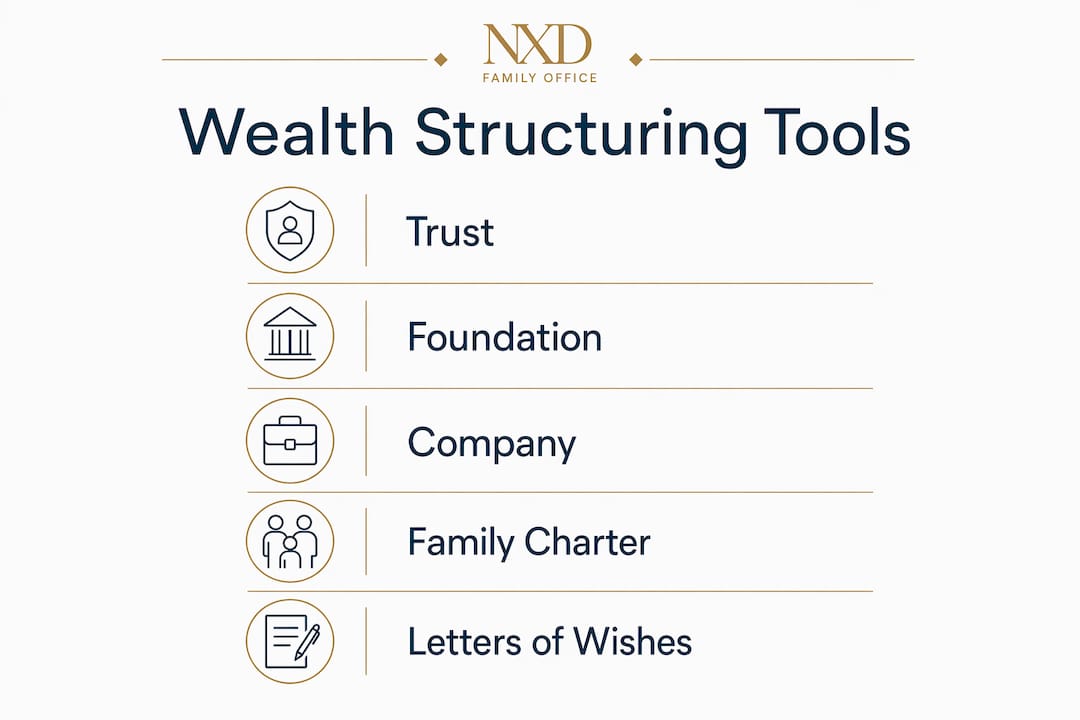
High net worth families increasingly use combinations of trusts, foundations, and companies to manage succession, philanthropy, and control with clarity and flexibility. The combination matters as much as the individual components.
Non-binding documents sit alongside these legal vehicles and are equally important. Family charters and letters of wishes are essential to align governance with the founder’s vision and prevent disputes that erode wealth. They carry no legal force, but they carry enormous practical weight in keeping families aligned.
How is private wealth structuring implemented in practice?
Implementation follows a clear lifecycle. Families who treat it as a one-time event consistently find their structures outdated within a decade. Those who treat it as an ongoing process maintain structures that remain fit for purpose as circumstances evolve.
- Asset mapping. Wealth structuring begins with asset mapping, identifying location, ownership, and value of assets globally, followed by gap analysis to align with long-term objectives such as succession, philanthropy, and creditor protection. This step often reveals assets held in suboptimal names or jurisdictions that create unnecessary exposure.
- Gap analysis. Once the asset map is complete, advisers assess the distance between the current position and the desired outcome. This is where succession objectives, philanthropy goals, and financial independence planning targets are translated into structural requirements.
- Structure design. Advisers, including tax counsel, legal specialists, and a coordinating family office, design the entity framework. This stage produces the blueprint: which vehicles, in which jurisdictions, holding which assets, with which governance documents.
- Implementation. Entities are incorporated, assets are transferred, and governance documents are drafted and signed. This stage requires careful sequencing to avoid triggering unnecessary tax charges during the reorganisation itself.
- Ongoing review. Structures that worked at liquidity events can become obsolete after 5–10 years due to changes in personal circumstances and tax laws. Annual reviews are the minimum standard. Major life events, such as a business sale, a marriage, or a change of domicile, should trigger an immediate reassessment.
Pro Tip: When selecting advisers, insist on a coordinating professional, typically a family office or lead counsel, who holds the whole picture. Specialist advisers working in silos produce structures that are individually sound but collectively incoherent.
What are the common misconceptions and risks to avoid?
The most persistent misconception in private wealth planning is that structuring is primarily a tax exercise. Asset protection and governance are equally critical to tax efficiency. Integrating non-tax goals prevents operational rigidity and legal vulnerability. Families who build structures around a single tax advantage often find that advantage legislated away, leaving them with a framework that serves no other purpose.
- Obsolete structures. A structure designed for a founder in their forties, running an operating business, may be entirely wrong for the same founder in their sixties, with a sold business and adult children. Structures age. Families change. The two must stay aligned.
- Overlooking the human element. The human element, often overlooked, requires alignment mechanisms such as family governance documents to prevent future litigation and ensure adherence to the founder’s values. A trust with no letter of wishes is an invitation to dispute.
- Insufficient risk isolation. Holding all assets in a single entity, even a well-chosen one, concentrates risk. A successful litigation claim, a regulatory action, or an insolvency event can reach everything. Proper structuring separates assets so that one problem cannot contaminate the whole.
- Complexity without purpose. More entities do not mean better protection. Every layer adds cost, administration, and regulatory reporting. Each structural element must justify its existence with a specific function.
How does effective structuring support long-term legacy and governance?
The most enduring structures are built around a family’s values, not just its assets. Governance is the mechanism that keeps those values operational across generations.

| Governance Tool | Function | Outcome |
|---|---|---|
| Family charter | Defines shared values and decision-making rules | Reduces conflict and aligns expectations |
| Letter of wishes | Guides trustees on the founder’s intentions | Preserves founder’s vision without legal rigidity |
| Succession plan | Maps control and equity transfer | Protects enterprise value and operational continuity |
| Family council | Provides a forum for collective decisions | Builds next-generation engagement and accountability |
Multi-entity planning enables families to carve and transfer equity interests according to bespoke succession objectives without compromising control or governance. This is the practical mechanism behind generational wealth transfer. It is not a single transaction. It is a series of deliberate steps, each designed to move value to the next generation while preserving the family’s ability to manage it.
The role of a family office in this process is to hold the governance framework together. A family office coordinates legal counsel, tax advisers, investment managers, and family members, ensuring that each decision reinforces the structure rather than undermining it. Without that coordination, even the best-designed structure drifts out of alignment over time.
Key takeaways
Private wealth structuring is the deliberate, ongoing organisation of assets, governance, and legal frameworks to protect family wealth, support succession, and preserve control across generations.
| Point | Details |
|---|---|
| Definition and scope | Private wealth structuring integrates legal, tax, and governance tools far beyond simple tax planning. |
| Core vehicles | Trusts, foundations, family limited partnerships, and private investment companies each serve distinct roles. |
| Implementation is a lifecycle | Structures require periodic review every 5–10 years and after major life events to remain effective. |
| Governance is non-negotiable | Family charters and letters of wishes prevent disputes and preserve the founder’s vision across generations. |
| Risk isolation matters | Multi-entity frameworks protect assets by separating liabilities, not just by reducing tax exposure. |
Why most families get this wrong until it is too late
I have seen families spend considerable time and money building what looks, on paper, like a sophisticated structure. Multiple entities, offshore trustees, tiered ownership. Then a business sale happens, or a marriage breaks down, and the structure that was never properly reviewed turns out to be entirely unfit for the moment it was supposed to serve.
The mistake is almost always the same. The structure was built once, by advisers who were excellent at their specific discipline, and then left to run. Nobody held the whole picture. Nobody asked whether the structure still matched the family’s actual situation five years later.
What most clients miss is not the legal mechanics. Those can be learned and delegated. What they miss is the governance layer. The conversations that need to happen between family members. The letter of wishes that was never written because it felt premature. The family charter that was discussed and then shelved because it felt too formal. These are the documents that determine whether a structure holds together under pressure or fractures at the worst possible moment.
My honest advice: treat your structure as a living document, not a completed project. The families who do this consistently are the ones whose wealth actually reaches the next generation intact.
— Alex Goldstein
How NXD Family Office can structure your wealth properly
NXD Family Office works with high net worth individuals and families who need more than a standard adviser relationship. The approach is built around unbiased guidance, free from referral fees or commissions, which means the advice you receive reflects your interests and nothing else.
From wealth management services and tax advisory through to private banking and lifestyle asset management, Nxdfamilyoffice coordinates the full picture across specialist advisers. Whether you are mapping assets for the first time, reviewing a structure built around a business you have since sold, or planning a generational transfer, the team holds the process together so nothing falls through the gaps. Consider it done.
FAQ
What is private wealth structuring in simple terms?
Private wealth structuring is the deliberate organisation of your assets across legal vehicles such as trusts, companies, and foundations to protect wealth, reduce risk, and support succession. It integrates legal, tax, and governance planning into a single coordinated framework.
Is wealth structuring only for tax purposes?
No. Asset protection, governance, privacy, and succession planning are equally important goals. A structure built solely around tax efficiency often becomes operationally rigid and legally exposed when personal circumstances or tax laws change.
How often should a wealth structure be reviewed?
Structures should be reviewed at least annually and reassessed after any major life event such as a business sale, marriage, divorce, or change of domicile. Structures established at liquidity events can become obsolete within 5–10 years without active management.
What is the difference between a trust and a foundation in wealth structuring?
A trust is the primary vehicle in common law jurisdictions, separating legal ownership from beneficial enjoyment. A foundation serves a similar purpose in civil law jurisdictions and is particularly suited to philanthropic objectives. Both can be combined within a broader structure.
Do i need a family office to manage my wealth structure?
A family office is not strictly required, but it provides the coordination function that prevents specialist advisers from working in silos. For families with complex, multi-jurisdictional assets, a coordinating family office significantly reduces the risk of structural drift and misalignment over time.