

Expert private client service integrates legal, tax, estate, and wealth management services into a single, coordinated strategy for high-net-worth individuals and families. It is not simply a solicitor drafting a will or an accountant filing a return. Done properly, it covers the full arc of personal wealth: protecting it, growing it, passing it on, and keeping it out of the hands of unnecessary tax liabilities.
For UK clients, the core disciplines include:
- Personal tax planning covering income tax, capital gains tax, and inheritance tax
- Trust and estate management including wills, probate, and succession structures
- Investment management with discretionary and advisory mandates
- International tax advisory for cross-border assets and residency matters
- Legal services such as Lasting Powers of Attorney and family succession planning
- Risk management and insurance planning tailored to complex personal circumstances
- Philanthropy advisory integrating charitable giving with tax efficiency
The multidisciplinary nature of this work is what separates genuine private client advice from fragmented, transactional services. When legal, tax, and financial planning operate in silos, the gaps between them cost clients money and create unnecessary risk.
What does private client service actually cover for tax?
UK personal tax is not straightforward for high-net-worth clients. Income from multiple sources, property portfolios, business interests, and offshore holdings all interact in ways that demand specialist attention rather than a standard self-assessment return.
Inheritance tax applies on estates above the nil-rate band, with rates and thresholds subject to current tax law and possible residence-based adjustments. For most wealthy families, that exposure is material. The planning response draws on business property relief, agricultural property relief, annual gifting allowances, and trust structures to reduce the liability legally and deliberately.

Capital gains tax adds another layer, particularly when assets are sold or transferred between family members. The interaction between CGT and IHT requires careful sequencing. Get it wrong and you trigger one tax while trying to mitigate the other. NXD Family Office’s tax advisory services address exactly this kind of interplay, with advice calibrated to each client’s full picture rather than a single transaction.
How bespoke financial planning works for wealthy families
Financial planning at this level goes well beyond a pension review. It covers cash flow modelling across decades, retirement income, philanthropic goals, and the orderly transfer of wealth to the next generation.
The advantage of coordinated planning is that legal, tax, and investment advice reinforce each other. A lifetime gifting strategy, for instance, only works if the investment portfolio is structured to release capital efficiently and the trust documentation is in place to receive it. Treating these as separate conversations produces gaps. Integrated private client advice avoids that fragmentation.
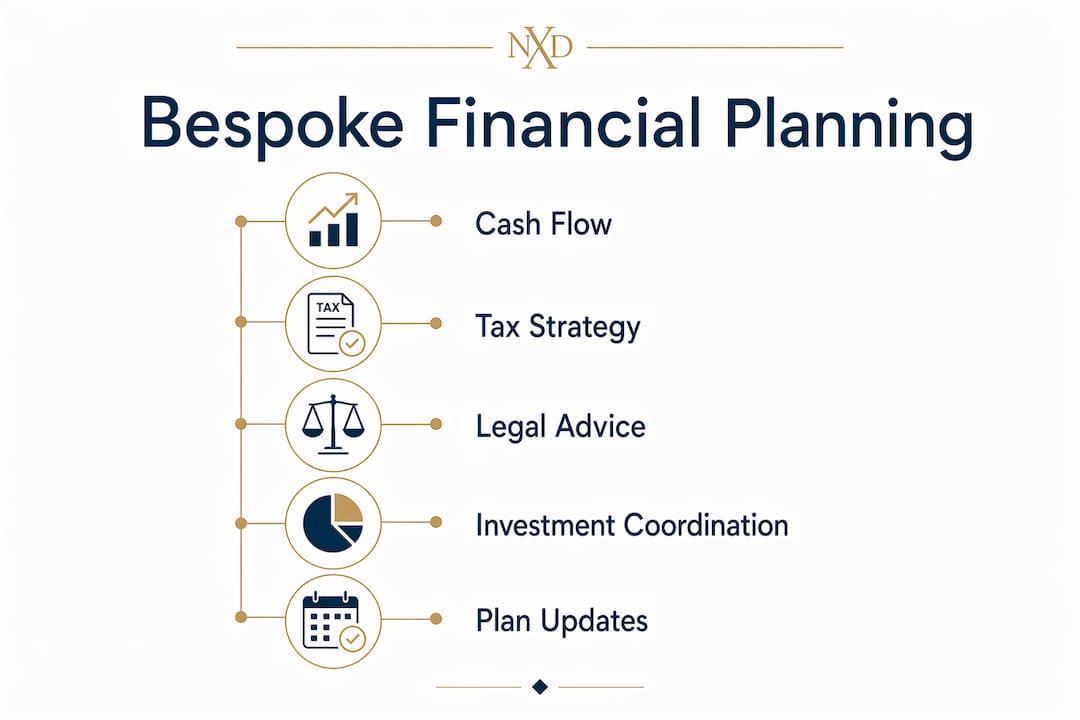
Bespoke financial plans are also living documents. Life changes: businesses are sold, families grow, residency shifts. A plan built in 2020 may be materially wrong by 2026. The best private wealth consulting relationships are built on regular review, not a one-off report filed in a drawer. For women managing their own wealth or navigating a transition, practical financial planning resources can complement professional advisory.
How investment management fits into private client work
Investment management for high-net-worth clients operates under either a discretionary or advisory mandate. Under a discretionary arrangement, the portfolio manager makes day-to-day decisions within an agreed framework. Under an advisory mandate, the client retains final say on each decision.
Risk profiling at this level goes beyond a standard questionnaire. It accounts for liquidity needs, tax position, existing asset concentration, and the timeline for wealth transfer. A client with a large illiquid business interest needs a very different portfolio construction to one whose wealth is already diversified across listed assets.
Access to alternative investments, including private equity, infrastructure, and real assets, is a genuine differentiator in private client investment management. These asset classes are not available through retail channels and require both the minimum investment thresholds and the advisory infrastructure to manage them properly.
International tax advisory for UK clients with global assets
Cross-border wealth creates compliance obligations that most generalist advisers are not equipped to handle. A UK-resident client with property in France, investments in the US, and a trust in Jersey faces reporting requirements across multiple jurisdictions simultaneously.

Double taxation treaties reduce the risk of the same income being taxed twice, but navigating them requires detailed knowledge of both UK law and the relevant foreign regime. The UK’s Foreign Income and Gains regime and the Temporary Repatriation Facility are particularly relevant for non-UK domiciled individuals following recent legislative changes.
Succession planning with offshore elements adds further complexity. Trust structures that are efficient under UK law may be treated very differently in another jurisdiction. Getting this right requires advisers who work across borders, not just within them.
Trust and estate management for preserving generational wealth
Trust and estate planning is the structural backbone of private client work. Trusts hold assets for beneficiaries, protect wealth from creditors, and provide a mechanism for transferring assets outside the estate for IHT purposes. Discretionary trusts, life interest trusts, and bare trusts each serve different purposes and carry different tax treatments.
Wills and probate sit alongside trust work. A professionally drafted will reduces the risk of a successful challenge and creates the opportunity to plan for tax efficiency at the point of death. Without one, the intestacy rules apply, and those rules rarely reflect a client’s actual wishes. The role of estate planning is particularly acute for clients who have built wealth quickly and have not yet formalised their succession intentions.
A large and increasing number of Lasting Powers of Attorney are registered each year, reflecting growing awareness that incapacity planning is important for many individuals. An LPA covering property and financial affairs gives a trusted person authority to act if mental capacity is lost, preventing the far more costly and time-consuming Court of Protection process.
Business relief and inheritance tax planning for family wealth
Business property relief (BPR) can reduce the IHT value of qualifying business assets by up to 100%, making it one of the most powerful tools available to family business owners. The qualifying conditions are specific: the asset must be a trading business, held for at least two years, and not mainly investment-based.
Family investment companies (FICs) have become a widely used structure for passing wealth to the next generation while retaining control. A parent transfers capital into the FIC, which then invests on behalf of the family. Shares are allocated to children or grandchildren, allowing future growth to accrue outside the parent’s estate. The tax treatment requires careful structuring, and the rules have attracted HMRC scrutiny, so specialist advice is not optional here.
Lifetime gifting remains a straightforward and underused tool. The annual exemption of £3,000 per person is modest, but larger gifts made more than seven years before death fall outside the estate entirely under the potentially exempt transfer rules.
Risk management and insurance planning
High-net-worth clients face risks that standard insurance products are not designed to cover. Art collections, classic cars, jewellery, and private aircraft require specialist valuations and bespoke policy terms. Underinsurance is common because standard policies apply generic replacement values rather than current market prices.
Life insurance, structured correctly within a trust, can provide liquidity to pay an IHT bill without forcing the sale of illiquid assets. This is particularly relevant for estates with significant property or business holdings. Income protection and critical illness cover also warrant review as part of any comprehensive financial plan, particularly for clients whose wealth is still tied to their own earning capacity.
Client onboarding and confidentiality protocols
Onboarding for private clients is more rigorous than most people expect. Ultra-high-net-worth private banking requires detailed Source of Wealth documentation, typically including two to three years of tax returns and twelve months of bank statements, to satisfy anti-money laundering regulations. This is not bureaucracy for its own sake. It protects clients as much as it protects the institution.
Confidentiality is non-negotiable. Private client relationships involve the most sensitive personal and financial information a client holds. Reputable advisers operate under strict professional obligations, including solicitor-client privilege and FCA conduct rules, that go well beyond a standard non-disclosure agreement. Managing family wealth discreetly is not a preference; for many clients, it is a condition of engagement.
How NXD Family Office delivers private client services differently
NXD Family Office takes a position that most traditional advisory firms are not willing to take: no referral fees, no commissions, no financial incentive to recommend one product over another. That matters because the traditional model has advisers with their hand in the client’s till, whether the client knows it or not.
The NXD approach brings together legal, tax, estate, and investment specialists under one coordinated framework, with each adviser focused on the client’s outcome rather than their own revenue. Bespoke solutions are built from scratch for each family, not adapted from a standard template.
Beyond the financial, NXD Family Office offers access to experiences that money alone cannot secure: Wimbledon tickets, behind-the-scenes tours of Northern Ballet, and private time with a current Formula 1 racing driver. These are not marketing gestures. They reflect a genuine understanding that high-net-worth clients want their lives managed as well as their assets. Exclusive events and lifestyle access are part of what a true family office delivers.
NXD Family Office works with high-net-worth individuals and families who expect more from their advisers. If you want coordinated, conflict-free private client advice across tax, legal, estate, and wealth management, speak to the NXD team today.
Key takeaways
Genuine private client service requires coordinated legal, tax, estate, and investment advice working together, not separately.
| Point | Details |
|---|---|
| IHT threshold and rate | Inheritance tax applies at 40% on UK estates above £325,000, making structured planning essential for most HNW families. |
| LPA registrations | Over 900,000 Lasting Powers of Attorney were registered in 2023, reflecting how central incapacity planning has become. |
| Integrated advice prevents gaps | Fragmented legal, tax, and investment advice creates costly inefficiencies that coordinated private client work avoids. |
| BPR and lifetime gifting | Business property relief and the potentially exempt transfer rules are among the most effective IHT mitigation tools available. |
| Onboarding rigour | Ultra-high-net-worth onboarding typically requires two to three years of tax returns and twelve months of bank statements. |
FAQ
What does a private client solicitor do?
A private client solicitor advises individuals and families on personal legal matters including wills, trusts, probate, inheritance tax, and Lasting Powers of Attorney, distinct from commercial or corporate legal work.
How much money do you need to access private client banking?
Entry thresholds for UK private client banking vary by institution. Coutts and C Hoare & Co require clients to have at least £3 million in investable assets, while high-net-worth services more broadly typically start from £1 million. Some international banks, such as HSBC UK Private Banking, may require £5 million or more.
Is client services the same as a collection agency?
No. Private client services refers to specialist legal, tax, and wealth management advice for individuals and families. It has no connection to debt collection or commercial recovery services.
Which bank has the best private client services in the UK?
The right private bank depends on your circumstances. Coutts suits UK-focused clients with £3 million or more; HSBC UK Private Banking suits those with international footprints, particularly across Asia and the Middle East, from £5 million in investable assets.