

Estate planning is the legal framework that stops the most common threats from eroding family wealth and secures who controls assets, funds, and care decisions when it matters most. For UK families, that means three things done well: a valid will, Lasting Powers of Attorney for both finance and health, and trust structures where assets or beneficiaries need extra protection. Get those right and your family avoids frozen bank accounts, contested estates, and the courts deciding who raises your children.
Why estate planning protects families: the immediate outcomes
- Faster access to cash: assets held in trust bypass probate entirely, giving trustees immediate access to funds for bills, care costs, and day-to-day expenses.
- Privacy: probate is a public process; trusts keep the details of your estate out of the public record.
- Control over timing: trusts let you specify when and how beneficiaries receive assets, protecting younger or vulnerable heirs from receiving a lump sum before they are ready.
- Protection from erosion: lifetime trusts can reduce the risk of assets being sold to fund residential care or divided in a beneficiary’s divorce.
- Tax efficiency: structured gifting, nil-rate band planning, and life insurance written in trust can reduce an inheritance tax (IHT) liability significantly.
Tactical next steps — start here:
- Make or review a will, naming executors, guardians for any minor children, and specific beneficiaries.
- Create Lasting Powers of Attorney for both property and financial affairs and health and welfare.
- Consider a lifetime or discretionary trust if you own property, have vulnerable beneficiaries, or face meaningful IHT exposure.
- Seek specialist advice from a solicitor or a coordinated adviser such as NXD Family Office if your estate includes a business, overseas assets, or a complex family structure.
This article is general information, not legal or financial advice. Confirm current rules with a qualified solicitor or the relevant primary source for your own situation.
Table of Contents
- What is estate planning in the UK and who needs it?
- The core protections families get from estate planning
- Key legal tools explained: wills, trusts, LPAs and advance decisions
- How estate planning reduces inheritance tax and other costs
- Protecting assets from care fees, divorce, creditors and probate delays
- Why professional drafting matters — and what poor drafting costs
- How to start: what to prepare and questions to ask an adviser
- When to review your estate plan
- Key takeaways
- The family-office view on why planning is an act of stewardship
- How NXD Family Office supports families with estate and wealth planning
- Useful sources and further reading
- FAQ
What is estate planning in the UK and who needs it?
Estate planning is the process of putting legal documents and structures in place to control what happens to your assets, your dependants, and your decision-making capacity during your lifetime and after your death. In a UK context, that covers wills, trusts, Lasting Powers of Attorney (LPAs), advance decisions, and the tax planning that sits around all of them.
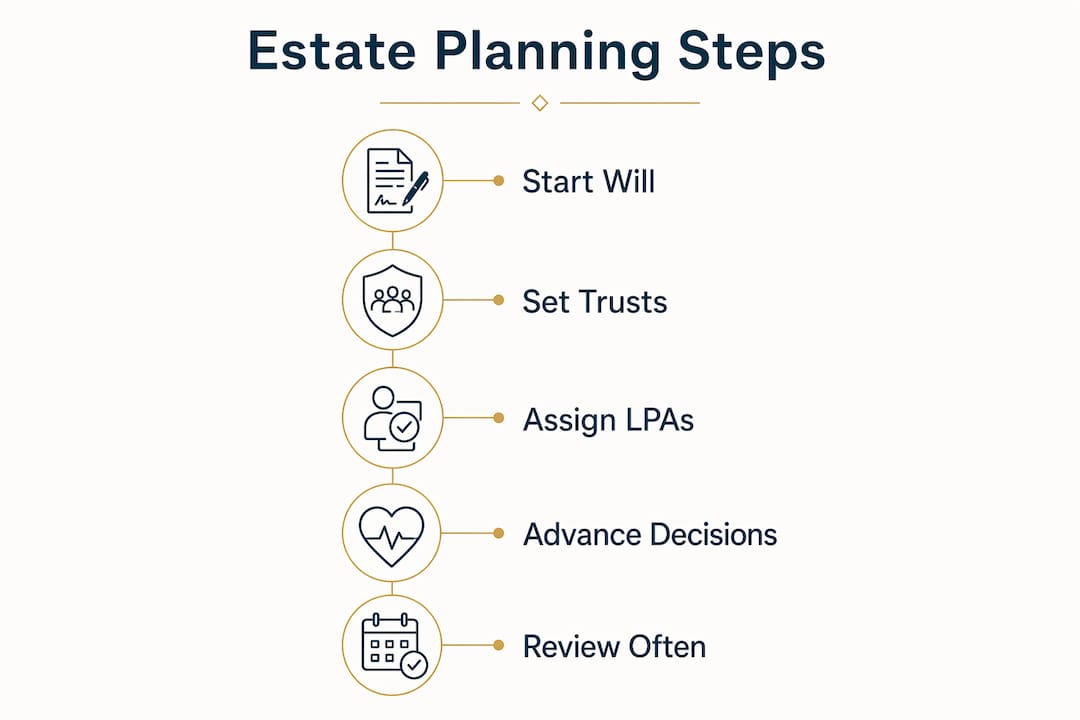
The scope is broader than most people assume. It is not just about who inherits the house. It covers who can access your bank account if you lose capacity, who raises your children if both parents die, and whether a beneficiary’s inheritance survives their divorce intact.
Who needs it most?
- Homeowners whose property pushes the estate above the nil-rate band threshold.
- Parents of minor children, for whom naming a guardian in a will is the only reliable way to direct that decision.
- Families with vulnerable dependants, where a trust can hold assets and provide ongoing support without triggering a loss of means-tested benefits.
- Business owners, where succession planning and business property relief interact directly with the estate.
- Blended families, where intestacy rules can leave cohabiting partners without provision and may exclude stepchildren entirely.
- Those with cross-border assets, where specialist advice is required because UK estate planning does not automatically govern assets held abroad.
One limitation worth stating plainly: estate planning cannot override criminal liability, cannot guarantee a will goes unchallenged, and cannot substitute for specialist cross-border legal advice where foreign jurisdictions are involved. It is a framework, not a guarantee.
The core protections families get from estate planning
The protections are concrete, not theoretical. Here is what well-structured planning actually delivers.
Financial continuity. Probate typically takes 3–12 months and can extend to 18 months where property sales are involved. During that period, sole-name assets are frozen. A family relying on a deceased partner’s current account for household bills faces a genuine liquidity crisis. Assets held in trust bypass this entirely: trustees can act immediately, paying care bills, school fees, or mortgage payments without waiting for a grant of probate.

Privacy. A grant of probate is a public document. Anyone can search the Probate Registry and see the value of an estate and who benefits. Assets held in trust do not pass through probate and remain private. For high-net-worth families, that privacy has real value beyond sentiment.
Control over distributions. A discretionary trust lets trustees decide when and how much each beneficiary receives. That matters when a beneficiary is young, has addiction issues, or is going through a divorce at the time of inheritance. A lump sum paid directly to that person could be lost; assets held in trust can be managed for their long-term benefit.
Protection of vulnerable beneficiaries. A will can set trusts for vulnerable beneficiaries and appoint specialist trustees, ensuring ongoing support without disrupting eligibility for means-tested support.
Residential care costs in the UK are commonly substantial, often requiring thousands of pounds per week. Tens of thousands of homes are sold each year to meet those bills. Lifetime trusts, structured correctly and well in advance, can reduce that risk for many families.
Business continuity. Without a succession plan, a business interest can be frozen alongside personal assets during probate, putting jobs and value at risk. Business property relief and clear succession documents can prevent that.
Key legal tools explained: wills, trusts, LPAs and advance decisions
Wills
A will is the foundation. It appoints executors to administer the estate, names beneficiaries, sets guardians for minor children, and can establish trusts within the document itself. Without one, the intestacy rules under the Administration of Estates Act 1925 apply, and those rules do not reflect modern family realities. A cohabiting partner of 20 years receives nothing under intestacy. A stepchild receives nothing unless specifically named.
The Inheritance (Provision for Family and Dependants) Act 1975 allows certain people to challenge a will or an intestate estate if they believe reasonable financial provision has not been made for them. A well-drafted will with a supporting letter of wishes reduces, though cannot eliminate, that risk.
Pro tip: A will does not automatically cover jointly owned assets or pension death benefits — these pass by survivorship or nomination respectively. Review both alongside your will.
Trusts
Trusts separate legal ownership (the trustee) from beneficial ownership (the beneficiary). That separation is what creates protection. A lifetime discretionary trust, set up while you are alive, can hold property or investments outside your personal estate, potentially reducing IHT exposure and protecting assets from care-fee assessment, divorce, or creditor claims.
Trustees can act without waiting for probate, providing immediate liquidity. The trade-off is ongoing administration: trusts require annual accounts, tax returns, and active trustee decisions. They are not a set-and-forget solution.
Lasting Powers of Attorney
An LPA appoints a trusted person to make decisions on your behalf if you lose mental capacity. There are two types: one for property and financial affairs, one for health and welfare. Both must be registered with the Office of the Public Guardian before they can be used, and registration takes time, so setting them up before any health concern arises is critical.
Without an LPA, a family member who wants to manage a loved one’s finances must apply to the Court of Protection for a deputyship order. That process is slower, more expensive, and gives the family far less control than a pre-registered LPA.
Advance decisions and advance statements
An advance decision (sometimes called a living will) is a legally binding document that refuses specific medical treatments in defined circumstances. It is narrow in scope but powerful: it can prevent unwanted interventions at end of life. An advance statement is broader but not legally binding; it records preferences and values to guide healthcare professionals. Both complement an LPA for health and welfare but do not replace it.
How estate planning reduces inheritance tax and other costs
IHT in the UK is charged at 40% on the value of an estate above the nil-rate band, currently £325,000. The residence nil-rate band (RNRB) adds up to a further £175,000 where a main residence passes to direct descendants, giving a combined threshold of £500,000 for a single person. Married couples and civil partners can transfer unused allowances, giving a combined potential threshold of £1,000,000.
Assets passing between spouses or civil partners are fully exempt from IHT regardless of value. That exemption does not apply to cohabiting partners, which is one of the most consequential planning gaps for unmarried couples.
| Tactic | What it does | Typical benefit | Key caveat |
|---|---|---|---|
| Lifetime gifts (seven-year rule) | Gifts made more than seven years before death fall outside the estate | Removes value from the taxable estate entirely | Taper relief applies in years 3–7; gifts made under financial pressure can be challenged |
| Discretionary trusts | Holds assets outside the personal estate | Reduces IHT exposure and protects against divorce/care costs | Periodic and exit charges apply; ongoing administration required |
| Life insurance written in trust | Policy pays out directly to beneficiaries, not into the estate | Provides immediate liquidity to pay an IHT bill without selling assets | Policy must be correctly written in trust at outset |
| Charitable giving | Gifts to qualifying charities are IHT-exempt; leaving 10%+ to charity reduces the rate to 36% | Reduces taxable estate and the effective IHT rate | Qualifying charity status must be confirmed |
| Business property relief (BPR) | Qualifying business assets attract 100% or 50% relief | Can eliminate IHT on business interests | Qualifying conditions are strict; relief is not guaranteed |
| Agricultural property relief (APR) | Similar relief for qualifying agricultural land | Significant for farming families | Subject to detailed qualifying rules |
Warning: Gifts made within seven years of death are brought back into the estate for IHT purposes on a tapering basis. Gifts made under pressure or without proper records are harder to defend. Remarriage resets the transferable nil-rate band calculation. And gifts can be challenged under the Inheritance (Provision for Family and Dependants) Act 1975 if they leave a dependant without reasonable provision.
- Never make large gifts purely for tax reasons without understanding the seven-year rule in full.
- Life insurance in trust is one of the most cost-effective IHT tools available, yet it is consistently underused.
- HMRC guidance on IHT reliefs changes; any plan built around BPR or APR needs regular review.
Protecting assets from care fees, divorce, creditors and probate delays
These four threats account for the majority of unplanned wealth erosion in UK families. Each has a specific planning response.
Care fees
Residential care in the UK can be expensive, often costing several thousand pounds per week. A local authority means test assesses assets above £23,250 (in England) as available to fund care. Property held in a lifetime trust, transferred well before any care need arises and not as a deliberate deprivation of assets, can reduce the risk of a forced sale. The timing and structure matter enormously: transfers made specifically to avoid care-fee assessment can be set aside by a local authority. This is an area where specialist legal advice is not optional.
Divorce and creditor exposure
A beneficiary’s inheritance paid directly to them becomes part of their personal assets and is therefore potentially divisible in divorce proceedings or available to creditors. Assets held in a discretionary trust are not owned by the beneficiary; trustees hold them and can exercise discretion about distributions. That distinction has protected family wealth in numerous contested divorce cases. The protection is not absolute, but it is meaningful.
Probate delays and liquidity risk
As noted above, sole-name assets are frozen during probate, which typically runs 3–12 months. The practical consequence: a surviving spouse may be unable to access a joint mortgage payment, school fees, or even household bills if the deceased held accounts solely. Structuring key accounts as joint tenancies, placing liquid assets in trust, and holding life insurance in trust all provide immediate access without waiting for probate.

Pro tip: Nominating beneficiaries on pension death benefit nominations and reviewing them after every major life event costs nothing and bypasses probate entirely. Most people set them once and never revisit them.
Realistic expectations
No structure provides absolute protection. A trust set up primarily to defeat creditors or avoid care fees can be unwound by courts. The Inheritance (Provision for Family and Dependants) Act 1975 gives courts wide powers to vary distributions. The goal is not to make an estate litigation-proof; it is to reduce risk, reduce ambiguity, and give your family the best possible starting position.
Why professional drafting matters — and what poor drafting costs
DIY will-writing services and online templates carry a well-documented risk: ambiguous wording that requires court intervention to interpret. That intervention costs far more than the original saving.
Solicitors are clear that poor drafting can fail to stand up in court. The risks include wills that fail to meet the formal execution requirements under the Wills Act 1837, LPAs with missing signatures or incorrect certification, trusts with unclear beneficial interests, and wills that inadvertently trigger IHT by failing to use available exemptions.
Tedford v Clarke [2025] EWHC 816 (Ch) is a recent example of what happens when a document is unclear. The case required judicial clarification of the testator’s intentions — a process that took court time, legal costs, and months of uncertainty for the family involved. The lesson is not that wills always go wrong; it is that ambiguity in a legal document is resolved by a judge, not by what the family believes the deceased intended.
The cost-benefit calculation is straightforward. A professionally drafted will and LPA package from a qualified solicitor typically costs a fraction of what a contested estate or Court of Protection application costs. For complex estates involving trusts, business interests, or overseas assets, specialist trust solicitors and family-office advisers add further value by modelling IHT exposure and coordinating across legal, tax, and financial disciplines.
When to use a solicitor rather than an online service: any estate above the nil-rate band, any family with minor children or vulnerable dependants, any business owner, any blended family, and any person with assets in more than one jurisdiction.
How to start: what to prepare and questions to ask an adviser
Preparation checklist
- Asset schedule: list all assets with approximate values — property, investments, savings, pensions, business interests, and overseas holdings.
- Title documents: locate property deeds and confirm whether property is held as joint tenants or tenants in common (the distinction affects how it passes on death).
- Existing documents: gather any existing will, LPAs, trust deeds, or advance decisions.
- Pension nominations: collect current death benefit nomination forms for all pension schemes.
- Family tree: note full names, dates of birth, and relationships for all potential beneficiaries, including stepchildren and cohabiting partners.
- Business interests: prepare a summary of any business ownership, shareholder agreements, or partnership arrangements.
- Overseas assets: list any foreign property, bank accounts, or investments and the jurisdiction in which they are held.
Questions to ask your adviser
- What is your experience with trust drafting and IHT modelling for estates of this complexity?
- How do you charge, and are there ongoing administration fees for any trusts you recommend?
- Can you model the IHT position under different scenarios (e.g., with and without lifetime gifts)?
- How will you coordinate with my accountant and financial adviser?
- What succession plan do you recommend for my business interest, and how does it interact with business property relief?
Red flags to watch for
- Any adviser who guarantees zero IHT without a detailed review of your full financial position.
- Unclear or bundled fee structures where estate planning is sold alongside unrelated financial products.
- Pressure to sign documents quickly without adequate time to review.
- Advisers who do not ask about your family structure, existing trusts, or overseas assets before making recommendations.
When to review your estate plan
An estate plan is not a one-time exercise. Life changes, and documents that were accurate three years ago may no longer reflect your wishes or your legal position.
Triggers for an immediate review:
- Marriage or civil partnership (a new marriage revokes an existing will in England and Wales unless it was made in contemplation of that marriage).
- Divorce or separation (an ex-spouse is treated as having predeceased for will purposes, but LPAs and pension nominations are not automatically updated).
- Birth or adoption of a child.
- Death of a named executor, trustee, or beneficiary.
- A significant change in the value of your estate, up or down.
- Moving abroad or acquiring overseas assets.
- Buying or selling a business.
- A change in tax law or IHT thresholds that affects your plan.
Suggested review rhythm: a light-touch check every 3–5 years to confirm documents still reflect your wishes; a full review with your adviser after any trigger event above, and again at retirement.
Pro tip: Keep a single document that records where all your estate planning documents are held, who your advisers are, and the date of your last review. Share its location with your executor. It costs nothing and saves enormous time.
Key takeaways
Estate planning legally protects families by controlling who owns assets, who accesses funds, and who makes decisions — without it, the law decides, and the law rarely matches what families actually want.
| Point | Details |
|---|---|
| Start with a will and LPAs | These two documents alone prevent the most common and costly outcomes: intestacy disputes and loss of financial control during incapacity. |
| Trusts add targeted protection | Discretionary trusts shield assets from care-fee assessment, divorce, and probate delays — but require ongoing administration and specialist drafting. |
| Probate freezes sole-name assets | Probate typically takes 3–12 months; trusts and joint ownership provide immediate liquidity without waiting for a grant. |
| Review after every major life event | Marriage revokes a will in England and Wales; divorce does not update LPAs or pension nominations automatically. |
| NXD Family Office coordinates the whole picture | For complex estates, NXD Family Office connects families with vetted solicitors, trust specialists, and IHT modellers through a single, fee-transparent mandate. |
The family-office view on why planning is an act of stewardship
Most families do not think about estate planning until a crisis forces the issue. A sudden illness, a death without a will, a frozen account at the worst possible moment. The frustration is that almost every one of those crises is preventable.
What the conventional wisdom misses is that estate planning is not primarily about death. It is about control during life. An LPA is not a morbid document; it is the thing that stops a court appointing a stranger to manage your finances if you have a stroke at 55. A trust is not a tax dodge; it is a structure that keeps assets working for your family rather than being consumed by care fees or divided in someone else’s divorce.
The families who handle wealth transitions well share one characteristic: they treat planning as a continuous process, not a one-off task. They review documents after life events. They coordinate their solicitor, their accountant, and their financial adviser rather than letting each work in isolation. They understand that a will drafted without reference to the IHT position, or an LPA registered without considering who the right attorney actually is, can create as many problems as it solves.
A family office approach does not replace the solicitor or the tax adviser. It coordinates them. It ensures that the legal structure, the tax plan, and the family’s actual wishes are aligned, and that someone is watching for the law changes that make last year’s plan obsolete.
*— Alex Goldstein
How NXD Family Office supports families with estate and wealth planning
For families with complex estates, the gap between having documents and having a plan that actually works is often a coordination problem. A will drafted without reference to the IHT position, or a trust set up without considering care-fee timing, can create as many problems as it solves.
NXD Family Office gives high-net-worth families access to a vetted network of solicitors, trust specialists, and tax advisers, coordinated through a single mandate with full fee transparency. No referral fees, no commission uplift, no adviser with a hand in the till. Clients receive bespoke IHT modelling, trust structuring, LPA coordination, and succession planning for business interests, all managed as a joined-up exercise rather than a series of disconnected appointments.
The approach is discreet by design. For families who value privacy, managing wealth discreetly is as much a part of the service as the legal and tax work. Trusts keep estate details out of the public record; the family-office structure keeps the coordination out of sight.
To discuss your estate planning position in confidence, visit the NXD Family Office wealth management services page or contact the team directly for an initial, no-obligation conversation.
Useful sources and further reading
- GOV.UK: Trusts and taxes — HMRC’s primary guidance on how trusts are taxed in the UK, including IHT periodic and exit charges.
- GOV.UK: Make a will — Official guidance on making a valid will in England and Wales, including execution requirements and the role of the Office of the Public Guardian for LPAs.
- Birketts: What happens if I don’t make a will? — Solicitors’ explanation of intestacy rules and how they affect cohabiting partners, stepchildren, and blended families.
- Morecrofts: Why every adult should make a will — Practical guidance on drafting risks and the consequences of poor execution, including reference to Tedford v Clarke (2025).
- MP Estate Planning: Estate planning for high-net-worth individuals — Covers probate timelines, trust structures, and liquidity planning for larger estates.
- MP Estate Planning: Do you need estate planning under £325,000? — Explains care-fee erosion risks and how lifetime trusts can protect family assets.
- Gunnercooke: Why modern families need estate planning — Focused on blended families, cohabiting couples, and same-sex couples whose needs are not met by default rules.
- NXD Family Office: Legal services for estate and business exit planning — NXD Family Office’s coordinated legal and estate planning service for complex mandates.
FAQ
What are the two most important purposes of estate planning?
Protecting your loved ones and preserving your assets for the people you intend to benefit. Estate planning secures decision-making during incapacity through LPAs and protects dependants by directing assets to the right people rather than relying on intestacy rules.
Who benefits most from estate planning?
Parents of minor children, blended families, business owners, and anyone with assets above the nil-rate band benefit most. Cohabiting partners are particularly at risk without a will, as intestacy rules provide them with no automatic entitlement.
What is the most common inheritance mistake?
Dying without a valid, up-to-date will. Intestacy can leave cohabiting partners without provision and may exclude stepchildren entirely, often producing outcomes the deceased would never have chosen.
How do trusts protect families during probate?
Assets held in trust bypass probate entirely, giving trustees immediate access to funds. This avoids the 3–12 month freeze that applies to sole-name assets and prevents the liquidity crises that often follow an unexpected death.
When should I review my estate plan?
After any major life event: marriage (which revokes an existing will in England and Wales), divorce, birth of a child, death of an executor or beneficiary, or a significant change in the value of your estate. A light-touch review every 3–5 years is good practice regardless.